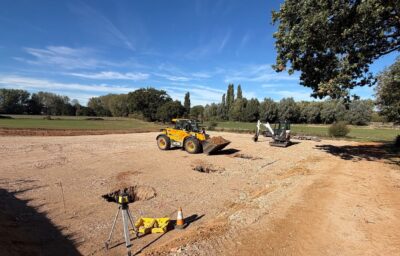
New Farm Yards and Hardstanding: What Farmers Can Lay Under Permitted Development
A good yard is the backbone of a working farm. Every farmer who has fought through a wet winter knows the cost of mud: lost working days, lame stock, machinery bogged in, feed wasted and soil carried out onto the road. Laying a proper concrete or hardcore yard is one of the most practical investments a farm business can make in animal welfare, safety and efficiency. The law recognises that. On a holding of 5 hectares or more, a new yard or hardstanding can often be laid under permitted development without a full planning application. The rules are precise, however, and two numbers trip people up time and again: 1,500 square metres and 0.5 hectares. Farmers who understand them can get on and build with confidence. Farmers who confuse them risk enforcement, and the enforcement time limit is now ten years for any breach after 25 April 2024.
What Permitted Development Allows on Farms of 5 Hectares or More
Class A of Part 6, Schedule 2 to the Town and Country Planning (General Permitted Development) (England) Order 2015 permits "any excavation or engineering operations" on agricultural land within a unit of 5 hectares or more, provided they are reasonably necessary for the purposes of agriculture within that unit. Laying a yard or hardstanding is an engineering operation, so it sits within Class A(b).
The right is a strong one, but it comes with firm boundaries. The work must be reasonably necessary for agriculture on that holding, not simply convenient. It must be designed for agricultural purposes (paragraph A.1(d)). It cannot be carried out on a separate parcel of the unit that is less than 1 hectare in area (A.1(a)). No part of it can be within 25 metres of the metalled part of a trunk or classified road (A.1(h)). A yard used to hold livestock or to store slurry cannot be laid under Class A within 400 metres of the curtilage of a protected building, which in broad terms means a neighbouring house or other occupied building that is not part of the farm (A.1(i)). These rules apply in England only. Wales and Scotland have their own regimes.
The Two Numbers That Matter: 1,500 Square Metres and 0.5 Hectares
The first number is the size limit. Since 21 May 2024, when SI 2024/579 amended Class A, the permitted development limit for concrete yards and other engineering operations has been 1,500 square metres. The limit is cumulative. Paragraph D.1(2)(a) requires you to add in the ground area of any building, structure, works, plant, machinery, ponds or tanks on the same unit that have been provided in the previous two years, where any part of them is within 90 metres of the new yard. A shed built last spring next to the proposed yard therefore eats into the allowance. That is not a ceiling on what your farm can have. There is no upper limit on the size of a yard as such; above 1,500 square metres the route simply changes from permitted development to a full planning application.
The second number is a prior approval trigger, not an allowance. Under paragraph A.2(2)(c), where the work involves excavations or the deposit of waste material and the relevant area exceeds 0.5 hectares, you must apply to the council for a determination on siting before you start. The relevant area is defined in paragraph D.1(4) and is cumulative across the whole unit with no time limit: it is the area of the new excavation or deposit, plus every other excavation on the holding that has not been filled, plus every other part of the holding where waste has been deposited and not removed. Below that figure, the excavation and deposit element needs no prior approval. Above it, you apply, and you do not begin until the council confirms prior approval is not needed, grants it, or the 28 day period passes without a decision.
This is where many people fall foul. The 0.5 hectare figure is not permission to lay 0.5 hectares of yard. Half a hectare is 5,000 square metres, well beyond the 1,500 square metre permitted development limit. A yard can sit comfortably under the 0.5 hectare trigger and still need a full planning application.
Two further rules deserve attention. If the scheme includes a new or altered farm track, that is the formation of a private way, and it needs a prior approval application covering its siting and means of construction (A.2(2)(b)). If you are bringing in hardcore, crushed concrete or other waste material from off the farm, paragraph A.2(1)(c) only allows this where the material is used for a building or a hard surface and is incorporated into the works straight away. Stockpiling imported material for later use is not permitted development. Separately, using waste in construction normally needs a waste exemption from the Environment Agency, usually the U1 exemption, which should be registered before any material arrives.
What This Means for Your Farm Business
The farmers who get this right are the ones who plan the yard as part of the wider farm, rather than reacting to the worst patch of mud. Start by confirming that the holding is 5 hectares or more and that the yard sits on a parcel of at least 1 hectare. Map everything built or laid within 90 metres in the last two years and add it to the proposed yard area. Total every unfilled excavation and every area of deposited material across the whole unit to see where you sit against the 0.5 hectare trigger. Measure the distance to the nearest classified road and to the nearest neighbouring house, and check whether a new track is involved.
Keep a clear record as you go: dated photographs, drawings, invoices for materials and your waste exemption. With a ten year enforcement window, that paperwork is what proves the yard was lawful when it was laid. Finally, keep the yard in agricultural use. Letting it to a contractor, using it for storage unconnected to the farm, or turning it into parking for a diversification venture is a change of use that needs planning permission in its own right, and it can undermine the permitted development basis of the works themselves.
Where a yard needs to be larger than 1,500 square metres, or falls within one of the excluded areas, that is not the end of the road. It means a full planning application, there is no upper limit on what that route can secure, and a well evidenced agricultural case is usually a strong one.
Farming in the North West? Find out how we help farmers with farm planning in the North West, including Cheshire and Cumbria.
Read next: our agricultural permitted development guide, plus Not Every Farm Building Needs Planning Permission: A Guide to Temporary and Moveable Structures and Applying for a New Agricultural Barn: A Planning Checklist for Farmers.
How Foxes Rural Can Help
Every yard is different, and the line between permitted development, prior approval and a full planning application often depends on what has already been built on the holding and where. Foxes Rural works alongside farm businesses across the UK to check the position, prepare prior approval and planning applications and get new yards and hardstanding approved correctly first time, drawing on a practical understanding of what local planning authorities expect to see. If you are planning a new yard or hardstanding and want to check your position before you start, call us on 01206 481981 or get in touch through our Contact page.