28 Day Glamping Right: What Farmers Need to Know
The 28-day permitted development right lets you use land on your farm as a glamping site for up to 28 days a year — no planning permission required. It's one of the most useful tools for farmers who want to test a glamping idea before committing to a full application, or who are waiting for planning to come through and want to generate some income in the meantime.
What the 28-Day Right Actually Is
The right sits in Part 4, Class B of the Town and Country Planning (General Permitted Development) (England) Order 2015 (GPDO). It grants planning permission for the temporary use of land for any purpose for a maximum of 28 days in any calendar year.
That's "any purpose." Glamping qualifies. So does a pop-up market, a film shoot, a car boot sale, or a one-off event. The right is broad by design.
There is one important carve-out within that 28 days. If you're holding a market or motor car or motorcycle racing, you're capped at 14 days — not 28. That sub-limit doesn't apply to glamping, so you get the full 28.
What the Right Covers — and What It Doesn't
Class B covers the use of land. It does not cover the erection of permanent or semi-permanent structures. If what you're putting on the field needs its own planning permission — a fixed glamping pod bolted to a base, a building, a hardstanding — Class B doesn't help you.
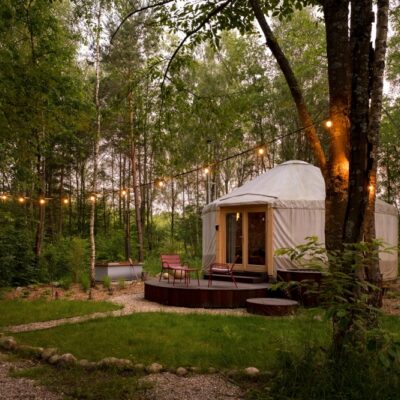
Bell tents, yurts assembled on temporary frames, tipi structures, and similar genuinely temporary arrangements are fine. The key test is whether the structure itself would ordinarily require planning permission. If it would, Class B does not cover it.
The right also cannot be used on land that forms the curtilage of a dwelling. If your field sits immediately next to the farmhouse and functions as part of the domestic garden, you cannot use Class B there. If it's a clear agricultural field — even one adjacent to the farmhouse — you're likely fine, though that boundary is fact-specific.
What Can You Operate Under the 28-Day Right?
In our experience working with farmers across Essex and the East of England, most people who ask about this right are thinking about bell tent or yurt glamping — a small number of pitches, seasonal use, no permanent infrastructure. That's exactly what Class B is designed for.
You can take bookings, charge guests, and run a commercial operation for those 28 days. There is no requirement for the use to be non-commercial.
What you cannot do is build any supporting infrastructure that would itself require planning permission — hardstandings, permanent toilet blocks, fixed power supplies to pods. Basic temporary welfare facilities — a chemical toilet in a shed, a generator — are more nuanced and depend on whether the installation constitutes "development" in its own right.
The 60-Day Camping Right — A Separate Permission Entirely
In July 2023, the government added a new class to Part 4 of the GPDO: Class BC. This is a distinct permitted development right that allows land to be used as a recreational campsite for up to 60 days in any calendar year, subject to no more than 50 pitches.
Class BC is specifically for camping — tents and, in certain circumstances, campervans and motor homes. It is not a general-purpose temporary use right in the way Class B is.
This matters for glamping because the two rights are separate. A farmer can, in principle, use Class B for 28 days and Class BC for 60 days on the same land in the same calendar year. The Lake District National Park Authority — itself a planning authority — has stated explicitly that the two permissions operate independently and can be used in combination.
The Cumulative Use Question
This is where farmers should proceed carefully. The position that Class B and Class BC can be stacked is the logical statutory reading, and it is supported by authoritative guidance. The rights are created by different statutory provisions with no cross-reference limiting one by the other.
That said, enforcement authorities don't always accept this analysis without question. At least one council has argued that combining Class B and Class BC camping uses on the same site in the same year does not constitute permitted development. That argument has not been definitively settled in the courts.
In practice, there is a meaningful distinction between using Class B for a different type of temporary use alongside Class BC camping — for example, using Class B for a pop-up food event on a day the campsite isn't operating — and attempting to use Class B to extend the camping season beyond the 60-day Class BC limit by running camping on the same days under a different label.
The former is straightforwardly defensible. The latter is the position that carries risk.
Does the 28-Day Right Apply in a National Park or AONB?
Class B applies across England, including in designated landscapes. There is no blanket exclusion for National Parks or Areas of Outstanding Natural Beauty. However, some conditions within the order are more restrictive in designated areas — and local enforcement teams in those areas tend to scrutinise temporary uses more closely.
If you are in a National Park, confirm the exact position with a specialist before relying on the right. The New Forest National Park, for example, has published specific guidance on pop-up camping and temporary uses that is worth reading alongside the legislation.
Three Practical Scenarios
Scenario 1 — Testing the market. A farmer in north Essex wants to run four bell tents for two weekends in August and one weekend in September. Total: approximately 14–16 days. Class B covers this comfortably, with days to spare.
Scenario 2 — Combining rights. The same farmer wants to run 20 tent pitches for a longer season. They use Class BC for 60 days of tent camping across June, July, and August. They then use the remaining Class B allowance for a one-off harvest supper event in October. The two uses are clearly distinct. This is the defensible way to combine rights.
Scenario 3 — Attempting to extend. A farmer has exhausted their 60 Class BC days and wants to run camping for a further two weekends in September. They argue the remaining Class B days cover it. This is the contested position. It may not survive enforcement scrutiny, and any income generated from that use carries risk.
Frequently Asked Questions
Can I use the 28-day right for glamping pods?
Only if the pods are genuinely temporary and do not themselves constitute development. A bell tent or freestanding yurt on temporary groundworks is likely to qualify. A pod fixed to a permanent base almost certainly does not. The structure must be removable without leaving any permanent footprint.
Do I need to notify the council before I use the 28-day right?
No prior notification or application is required under Class B. The permission is automatic. You should, however, keep records of the days you use the right in case you need to demonstrate compliance with the annual limit.
Can I use the 28-day right and the 60-day camping right in the same year?
As separate statutory rights, yes — provided the uses are genuinely distinct. Using Class B to extend a camping season that has already exhausted the Class BC allowance is the riskier approach and could be challenged by the local planning authority. Take specialist advice before combining the rights in that way.
What happens if I exceed 28 days under Class B?
Use beyond 28 days without planning permission is a breach of planning control. The local planning authority can issue an enforcement notice. There is no automatic immunity from enforcement, and exceeding the limit — even unintentionally — removes the protection the right provides.
Does the 28-day right apply to my whole farm or just one field?
Class B applies to any unit of land. If you have multiple distinct fields, you may in principle use each one for up to 28 days. However, where fields are clearly operated as one continuous glamping site, a planning authority is likely to treat them as a single unit of use. Don't rely on subdividing a single operation across nominal field boundaries to multiply your allowance.
What to Do Next
The 28-day right is a useful starting point — but it has real limits, and combining it with Class BC needs careful thought. If you want to build a glamping business rather than just test the water, you'll need to look at planning permission for a permanent or longer-term site.
Foxes Rural advises farmers across England on glamping planning strategy, from using permitted development rights correctly through to full planning applications and appeals. Contact us to talk through your site.