Padel Courts on Farms: What Planning Permission Do You Need?
Padel Courts on Farms: What Planning Permission Do You Need?
Padel is the fastest-growing sport in the UK. Courts are appearing everywhere, and farmers are starting to ask whether one could work as farm diversification. The answer is yes. But the planning position is more layered than most people realise — and getting it wrong costs money.
Does a Padel Court Need Planning Permission?
The change of use from agricultural land or buildings to a padel court is development. That means you need planning permission, or a permitted development right must apply.
Whether a permitted development route exists depends on one question: is the court going inside an existing agricultural building, or is it going outside on open land?
The answer changes everything.
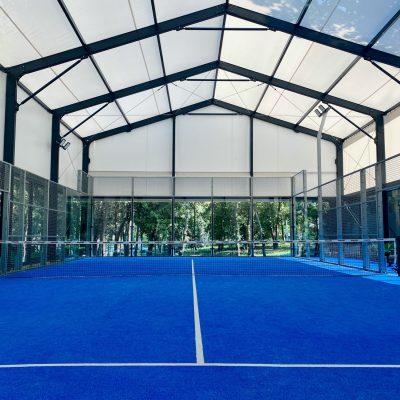
Indoor Padel Courts: Class R May Apply
If you are putting a padel court inside an existing agricultural building, that use falls within Class E(d) of the Town and Country Planning (Use Classes) Order 1987 (as amended). Class E(d) covers indoor sport, recreation or fitness not involving motorised vehicles or firearms.
Class R of Part 3, Schedule 2 of the GPDO 2015 permits the change of use of an agricultural building — and land within its curtilage — to Class E use, without requiring a full planning application. Prior approval is required for buildings over 150 sq m.
This is a significant opportunity. A farmer with a redundant grain store or machinery barn that can physically accommodate a padel court may be able to change the use via prior approval rather than a full application. The 1,000 sq m cap across the agricultural unit applies. The building must have been in solely agricultural use as part of an established agricultural unit on or before 3 July 2012 (or for 10 years if built after that date).
One important caveat: Class R permits the change of use only. The physical works to fit out the court — the frame, glazed panels, surface — are operational development. Those require a separate planning application. So Class R gets you the use; it does not get you the building works.
Outdoor Padel Courts: A Different Route
An outdoor padel court on agricultural land falls within Class F2(c) — outdoor sport or recreation not involving motorised vehicles or firearms. Since 21 May 2024, Class R also permits change of use to Class F2(c). This means an agricultural building and its curtilage can change to an outdoor sport use via prior approval.
However, most outdoor padel courts go on open agricultural land, not within the curtilage of an existing building. Class R does not apply to open land standing apart from a building. For open land, you need full planning permission for the change of use.
And the physical court structure itself — frame, fencing, surface, lighting — requires planning permission regardless.
What the NPPF Says About Farm Diversification
Full planning applications for padel courts on farms have a strong policy hook. The December 2024 NPPF at paragraph 88 requires planning policies and decisions to support a prosperous rural economy. Paragraph 89 specifically recognises agricultural diversification as part of that.
A padel court generating rental income on a working farm is a diversification use. That is a material consideration in your favour. It does not guarantee consent — but a well-argued application has legitimate national policy support.
In our experience working with farmers across Essex and the East of England, officers are most receptive when the diversification enterprise is genuinely connected to the farm business and the income it generates is reinvested in that business.
The Planning Issues That Trip Farmers Up
Lighting
Most commercial padel courts are lit. Artificial lighting on an outdoor sports facility in a rural area is one of the most sensitive planning issues you will encounter. Light spill, impact on the night sky, and proximity to protected habitats all need to be addressed. A lighting design statement is almost always required.
Landscape impact
Courts require a frame, glazed panels, and fencing. In an open rural landscape, these are visible structures. Your application will need to address landscape impact, and a landscaping scheme will almost always be required as a condition.
Designated land
If your farm is in the Green Belt, a National Landscape, or a conservation area, the policy tests are harder. Green Belt policy at NPPF paragraph 155 does not treat outdoor sport as inappropriate development in principle. But a padel court with its frame, lighting, and associated hardstanding can harm the openness of the Green Belt. Each case turns on its specific facts.
Associated infrastructure
Car parking, highway access, surface water drainage, and potentially toilets and changing facilities all need to be addressed. These are not afterthoughts — they are material planning matters that should be resolved before an application is submitted.
A Real-World Scenario
We recently advised a farming family in north Essex with a redundant agricultural building on the edge of their farmyard. They wanted to know whether they could convert it to an indoor padel court. Because the building was a Class R-eligible structure, the change of use to Class E(d) was achievable via prior approval rather than a full application.
The physical fit-out works required a separate application. The lighting was the hardest issue — the farm bordered a nature reserve. We commissioned a lighting designer early, specified directional downlights with strict cut-off angles, and agreed an operating hours condition with the LPA. Both applications were approved.
The lesson: the Class R route reduced risk significantly compared to a full change of use application. And resolving the lighting question early — before submission, not after — prevented a refusal.
Frequently Asked Questions
Can I use Class R permitted development rights for a padel court?
Yes, in certain circumstances. If the court is going inside an existing eligible agricultural building, the change of use to Class E(d) (indoor sport) can be pursued via Class R prior approval. If the court is within the curtilage of an existing agricultural building, the change to Class F2(c) (outdoor sport) may also qualify via Class R since 21 May 2024. Open agricultural land with no curtilage connection to a building does not benefit from Class R and requires full planning permission.
Does Class R cover the building works as well as the change of use?
No. Class R permits the change of use only. The physical works — frame, glazing, surface, fencing — are operational development and require a separate planning application. Both need to be in order before work starts.
Does a padel court count as farm diversification for planning purposes?
Yes. The December 2024 NPPF at paragraphs 88 and 89 supports agricultural diversification as part of a prosperous rural economy. A padel court generating rental income on a working farm can legitimately be presented as a diversification enterprise, both in a prior approval submission and in a full planning application.
What is the floorspace limit for Class R?
1,000 sq m cumulative across the established agricultural unit, following the increase that came into effect on 21 May 2024. Buildings under 150 sq m require only notification to the LPA. Above 150 sq m, prior approval is required.
Will my farm be in the Green Belt affect the application?
Green Belt does not automatically rule out a padel court. NPPF paragraph 155 identifies outdoor sport and recreation as not inappropriate development in the Green Belt. But the physical structure of a padel court — frame, lighting, associated hardstanding — can harm openness. A Green Belt site needs careful assessment before you commit to a design or a location.
The Bottom Line
Padel courts are a genuine farm diversification opportunity, and the planning routes are better than most farmers realise. An indoor court in an eligible building may qualify for Class R prior approval. An outdoor court on open agricultural land needs full planning permission, but has strong national policy support under the December 2024 NPPF.
Get the route right before you spend money on designs. Talk to Foxes Rural at the start of the process, not after a refusal.